TestPlan Expansion
How FHIR Frog expands TestPlans into executable JUnit tests.
Expansion Process
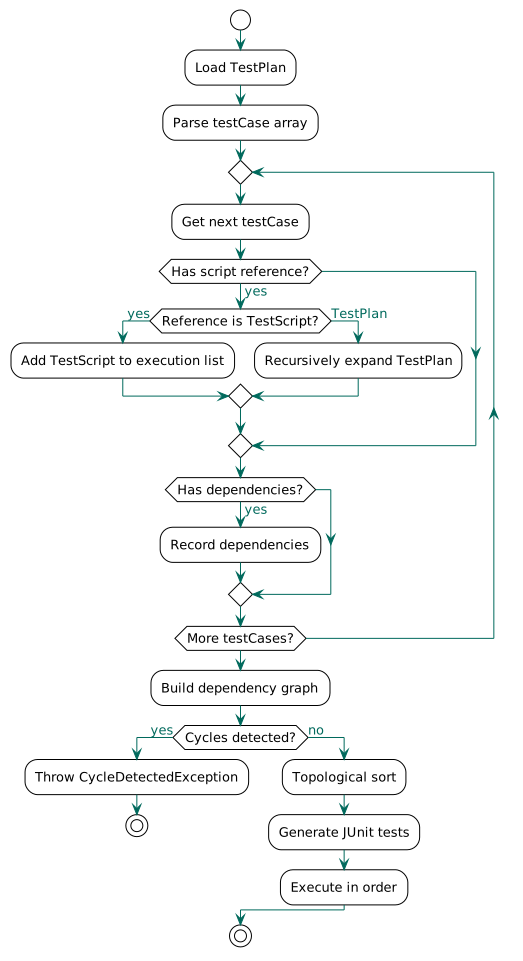
TestPlans are dynamically expanded at runtime:
- Load TestPlan - Read from server or classpath
- Resolve references - Load referenced TestScripts/TestPlans
- Build dependency graph - Analyze dependencies
- Detect cycles - Fail if circular dependencies found
- Topological sort - Determine execution order
- Generate JUnit tests - Create dynamic test methods
- Execute - Run tests in order
Simple Expansion
TestPlan
{
  "resourceType": "TestPlan",
  "id": "patient-suite",
  "testCase": [
    {
      "testRun": [
        {"script": {"reference": "TestScript/patient-create"}},
        {"script": {"reference": "TestScript/patient-read"}},
        {"script": {"reference": "TestScript/patient-delete"}}
      ]
    }
  ]
}
Expanded JUnit Tests
@TestPlan("TestPlan/patient-suite")
class PatientSuite {

    @Test
    @DisplayName("patient-create")
    void testPatientCreate() {
        // Execute TestScript/patient-create
    }

    @Test
    @DisplayName("patient-read")
    void testPatientRead() {
        // Execute TestScript/patient-read
    }

    @Test
    @DisplayName("patient-delete")
    void testPatientDelete() {
        // Execute TestScript/patient-delete
    }
}
Recursive Expansion
Nested TestPlans
{
  "resourceType": "TestPlan",
  "id": "au-core-suite",
  "testCase": [
    {
      "testRun": [
        {"script": {"reference": "TestPlan/patient-suite"}},
        {"script": {"reference": "TestPlan/practitioner-suite"}}
      ]
    }
  ]
}
Expanded Structure
AUCoreSuite
├── PatientSuite
│   ├── patient-create
│   ├── patient-read
│   └── patient-delete
└── PractitionerSuite
    ├── practitioner-create
    ├── practitioner-read
    └── practitioner-delete
Dependency Expansion
With Dependencies
{
  "testCase": [
    {
      "sequence": 1,
      "testRun": [{"script": {"reference": "TestScript/setup"}}]
    },
    {
      "sequence": 2,
      "dependency": [{"predecessor": "TestScript/setup"}],
      "testRun": [
        {"script": {"reference": "TestScript/test1"}},
        {"script": {"reference": "TestScript/test2"}}
      ]
    }
  ]
}
Expanded with Order
@TestPlan("TestPlan/with-deps")
class WithDependencies {

    @Test
    @Order(1)
    @DisplayName("setup")
    void testSetup() {}

    @Test
    @Order(2)
    @DisplayName("test1")
    void testTest1() {}

    @Test
    @Order(2)  // Same order - can run in parallel
    @DisplayName("test2")
    void testTest2() {}
}
Expansion Diagram
Cycle Detection
Detection Algorithm
public void detectCycles(TestPlan plan) {
    Set<String> visiting = new HashSet<>();
    Set<String> visited = new HashSet<>();

    for (TestCase testCase : plan.getTestCase()) {
        if (hasCycle(testCase, visiting, visited)) {
            throw new CycleDetectedException();
        }
    }
}
Example Cycle
Error:
Execution Order
Topological Sort
Input Dependencies:
  A: []
  B: [A]
  C: [A]
  D: [B, C]

Topological Sort:
  Level 1: A
  Level 2: B, C (parallel)
  Level 3: D
JUnit Execution
@TestPlan("TestPlan/sorted")
class SortedTests {

    @Test
    @Order(1)
    void testA() {}

    @Test
    @Order(2)
    void testB() {}

    @Test
    @Order(2)  // Parallel with testB
    void testC() {}

    @Test
    @Order(3)
    void testD() {}
}
Dynamic Test Generation
JUnit 5 TestFactory
@TestFactory
Stream<DynamicTest> expandTestPlan() {
    TestPlan plan = loadTestPlan("TestPlan/suite");
    List<TestScript> scripts = expand(plan);

    return scripts.stream()
        .map(script -> DynamicTest.dynamicTest(
            script.getName(),
            () -> executeTestScript(script)
        ));
}
Nested Containers
@TestFactory
Stream<DynamicContainer> expandNestedTestPlan() {
    TestPlan plan = loadTestPlan("TestPlan/nested");

    return plan.getTestCase().stream()
        .map(testCase -> {
            List<DynamicTest> tests = expandTestCase(testCase);
            return DynamicContainer.dynamicContainer(
                testCase.getNarrative(),
                tests.stream()
            );
        });
}
Expansion Limits
Maximum Depth
Prevent infinite recursion:
private static final int MAX_DEPTH = 10;

public List<TestScript> expand(TestPlan plan, int depth) {
    if (depth > MAX_DEPTH) {
        throw new MaxDepthExceededException();
    }
    // Expand...
}
Maximum Tests
Limit total test count:
private static final int MAX_TESTS = 1000;

public List<TestScript> expand(TestPlan plan) {
    List<TestScript> scripts = new ArrayList<>();
    expandRecursive(plan, scripts);

    if (scripts.size() > MAX_TESTS) {
        throw new TooManyTestsException();
    }
    return scripts;
}
Performance
Caching
Cache expanded TestPlans:
private Map<String, List<TestScript>> cache = new HashMap<>();

public List<TestScript> expand(TestPlan plan) {
    String key = plan.getId();
    if (cache.containsKey(key)) {
        return cache.get(key);
    }

    List<TestScript> scripts = doExpand(plan);
    cache.put(key, scripts);
    return scripts;
}
Parallel Expansion
Expand independent branches in parallel:
public List<TestScript> expandParallel(TestPlan plan) {
    return plan.getTestCase().parallelStream()
        .flatMap(testCase -> expandTestCase(testCase).stream())
        .collect(Collectors.toList());
}
Best Practices
Keep It Simple
Avoid deep nesting. Aim for 2-3 levels maximum.
Watch Performance
Large TestPlans with many nested references can be slow to expand.
- Limit nesting depth - Max 2-3 levels
- Cache expansions - Reuse expanded plans
- Test expansion - Verify no cycles before production
- Monitor performance - Track expansion time
- Document structure - Explain TestPlan hierarchy
Next Steps
- Structure - TestPlan structure
- Dependencies - Managing dependencies
- Overview - TestPlan basics